About MEIF


Sustainable development and environmental management are particularly needed for the future of mankind. Continuing problems of pollution, solid waste disposal, degradation of environment, Global warming, and depletion of ozone layer and loss of biodiversity have made everyone aware of environmental issues. Myanmar Environmental Innovation Foundation, MEIF receives guidance of the Ministry of Natural Resources and Conservation officially formed as an education and research service.
Background History
Members of Myanmar Environmental Innovation Foundation, MEIF worked several EIA projects under the collaboration jobs of Resource & Environment Myanmar Company Limited, REM-UAE Consultant Company Limited, CRE Company Limited and a Research Institute namely Myanmar Environment Institute (MEI).
The partners of Resource & Environment Myanmar (REM), Myanmar Environment Institute (MEI), REM-UAE Consultant Company Limited and CRE Company Limited has consistently integrated corporate social responsibility into its environmental and resource management work. Their portfolio spans environmental impact assessments, social impact studies, hazard mapping, and consulting sustainable paths, but the most notable contributions are those that emphasizing community engagement, social safeguards, and participatory processes.
Early projects such as the 2010 multi-hazard risk assessment in Rakhine State under UNDP demonstrated a strong CSR commitment by building resilience and preparedness for vulnerable communities. Public meetings and household attitude surveys for the Dawei Main Road and Industrial Estate projects in 2012–2013 ensured that local voices were heard and incorporated into development planning. Similarly, the Village Heads and Household Attitude Survey for the Dawei Deep Sea Port project reflected a dedication to participatory dialogue and social accountability. The National Electrification Plan in 2013–2014, supported by the World Bank and Columbia University, carried a strong CSR element by expanding access to electricity and improving livelihoods. Climate resilience was addressed through the BRACED program in 2014, while sustainable resource management was promoted in the Ayeyarwaddy River Basin case study with the Stockholm Environment Institute.
More recent projects continued this CSR trajectory. The Mekong River Navigation Channel Improvement Project in 2018–2019 included social and economic surveys alongside public consultations, ensuring transparency and stakeholder involvement. In 2020, resettlement action plan studies for national power transmission and expressway development projects emphasized fair treatment of affected communities and safeguards for livelihoods. Importantly, the EIA study of the DG2P Project from Yephyu Township in Tanintharyi Region to Ayeyarwaddy and Yangon Regions (DGT Co., PTTEP) further reinforced CSR principles by addressing environmental and social impacts across multiple regions, ensuring that development was balanced with community and ecological considerations. This project exemplifies how CSR is embedded not only in social safeguards but also in long-term sustainability planning.
Together, these initiatives underline the consortium’s commitment to embedding CSR principles into infrastructure development, balancing technical rigor with social responsibility, and ensuring that communities remain central to Myanmar’s path toward sustainable growth.


Objectives
- To do environmental researches with great momentum at various places throughout Myanmar
- To carry out environmental audits to access the compliance of completed or on-going activities with the requirements relevant of legislations, environmental policies, environmental management systems and environmental schemes
- To offer environmental classes and trainings to fulfill the needs of government staffs, practitioners, and younger generations from environmental arena, to upgrade their skills and to raise environmental awareness of the community
- To support feasible projects on developing gender equity and social improvement studies in rural areas of Myanmar
- To do environmental monitoring and evaluation for physical environment, social environment and biological environment over time to provide information on environmental change and protect them from being negatively impacted by natural and man-made activities
- To give Environmental Awareness Program to Local People
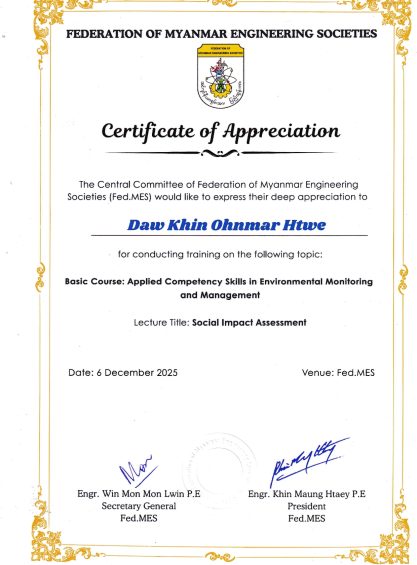
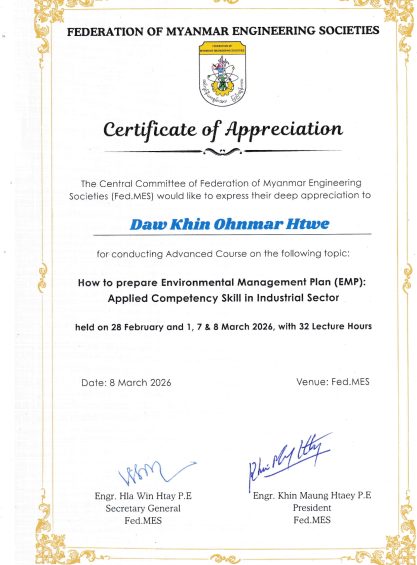
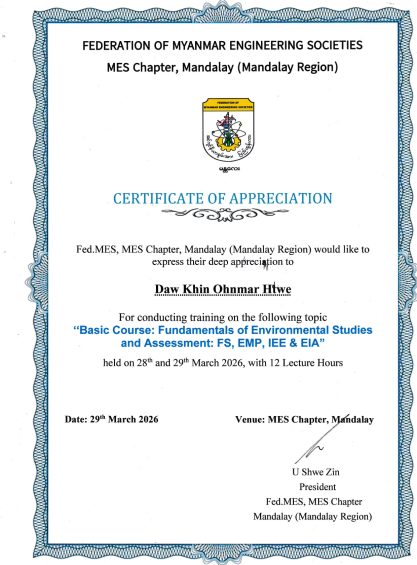
our certifications